Occasional Thoughts on Educational Technology and Life by Judy Brophy

Thursday, February 9, 2012

Motel Cabins


Abandoned Motel and CabinsWagon Wheel Lodge (3 of 4)Wagon Wheel Lodge (4 of 4)Sunset Court motel cabinsJohn's Modern Cabins Rt. 66Tip Top Motel (cabins) (2 of 2)
Row of abandoned motel cabinslittle pink cabinsDay Inns CabinsNine Mile Motel CabinsDCP_1029tiny beach cabins
Town n' Country Motel (#2 in a series)Outpost cabinsTroy's Cabin Camp aka Troy's Motor Court, New Hill, NCSeattle WA: Motor Inn cabins, Aurora Avenue, 1993Independence, CA, Mt. Williamson MotelNew Hampshire_20091126_081
Motel Cabins, a gallery on Flickr.

It was while working for the Census a number of years ago that I began to realize that many of the old motor courts and roadside cabins were in fact residences. Homes. That people actually lived in these re-purposed dwellings. 

I was trying to deliver census forms to places that might be used as living quarters, mostly to people who did not particularly want to be found. I discovered living in my midst were people in this substandard housing.

Were they glad to have this roof over their head or were they ashamed?
I feel profoundly conflicted about these places. Part of me says, “No one should have to live in these places.” But part of me knows that if I were penniless, I’d prefer to live in this kind of place than in a city tenement.

The gallery of images above was chosen from Flickr to illustrate this type of living situation, though I have no information about whether these units have been re-purposed for full time living. Thank you to all the Flickr photographers that allowed me to include their images here.

Thursday, January 19, 2012

Experiencing Art and Architecture Close Up

In what has become an ongoing series with me, here is another amazing animation of a building or art work, Frank Lloyd Wright's house Fallingwater.

Fallingwater from Cristóbal Vila on Vimeo.

Thanks again to that amazing blog Open Culture.
http://www.openculture.com/2012/01/fallingwater-one-of-frank-lloyd-wrights-finest-creations-animated.html

You may also be interested in:
Seeing Art Better
and
More Art to Experience

Friday, December 2, 2011

Monday, November 28, 2011

MORE Art to Experience

The great art gallery available on the web just keeps growing. While the web imposes some restrictions, it also allows additional features not available to the in-person viewer.

The University of Pittsburgh has published a digital version of its complete elephant portfolio of Audubon's Birds of America.
Prothonotary Warbler
The web version allows you to zoom in so close you cans see brush strokes. You can view metadata like the name of the engraver, and the size of the engraved plate, lest you forget that the birds were all drawn life-size.
You can even order reproductions and note cards.

To see Picasso's Guernica in an entirely new way, watch the YouTube animation Guernica 3D.

You are actually moving through the painting.

Guernica 3D
For more examples of unique ways to view art and architecture see a previous blog entry Seeing Art Better.

Wednesday, November 9, 2011

The Case for Learning Something Entirely Different

Image by Matthew Ragan
I bumped into a listing of 9 new tools for creating music online recently. I am no musician and don’t teach or create music, but the tools tempted me. What fun it would be to try out some of those tools and see what I could create.  

Why don’t we do more exploring into areas that we don’t know?

As a technology facilitator to faculty I have noticed that most people, teachers and student, (and I include myself here) want to go only where they have gone before, perfect something rather than try something entirely new.  When was the last time you tried something entirely new?
I can hear the arguments in my own head
  •        Well, it wouldn’t be any good.
  •        It wouldn’t be professional looking
  •       It would be too difficult
  •      All I would learn is that I can’t do it

But we would be missing something. We would be missing the adventure and the joy of figuring out a puzzle with only our wits, and the combined wisdom of the group to help us.
You might not learn to create a passable piece of music using the new tools, but you might learn:
  •   How you attack a problem you haven’t seen before
  •  How others do it (and could I do that?)
  •  Where the edge of your comfort zone is for not knowing what you’re doing
  •  When confronted with something new, what is your preferred way to learn? Ask a friend, find a book, google it?

Image by Matthew Ragan
When was the last time you and your class had a learning adventure? An activity which you didn’t know how it would turn out? That had not been carefully planned and constructed and all the possible hard spots and bumps removed? When did you learn something together?

I think I’ll try some of those tools... or maybe some Morris Dancing.

Sunday, September 4, 2011

Seeing Art Better

The second time we went to Italy we were careful to pack two pair of binoculars—not for the scenic mountain vistas, but for the building interiors and exteriors.


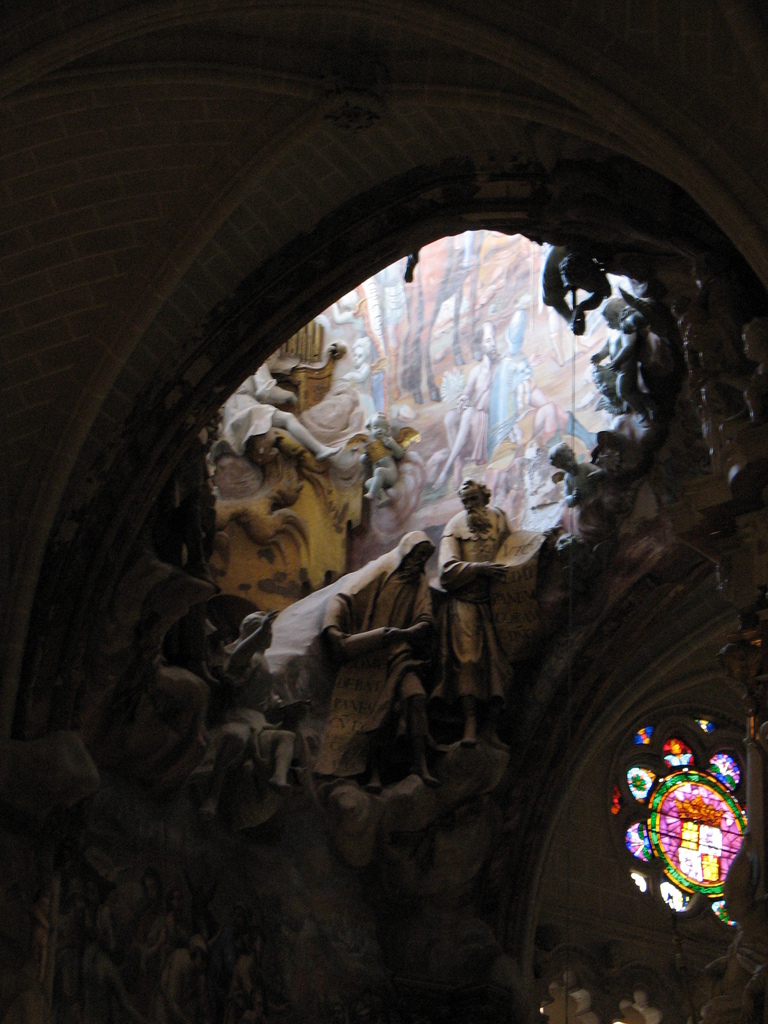
In photos of great art you always see it well-lit and close up. In the real world it is seldom either. The rococo hole in the roof masterpiece in the Toledo Cathedral, called the Transparente, for example, is so high and situated with light streaming through it that you can never get a good view of the statues surrounding the opening and peering down. Even the purchased guide book (another way to get detailed views without breaking your neck) has just one small badly lit picture.

Here’s where technology has given us a gift. Take for example, this bird's eye closeup of the Cathedral of Santiago de Compostella. It was taken with an Octocoptor, a tiny flying camera. (See here for more on this technology including how to build your own. And a quick shout out to http://www.openculture.com/  where I saw this video, which consistently amazes with its finds.)

Santiago de Compostela Cathedral by albertocvr oktokopter from albertocvr on Vimeo.

One of my favorite cathedral exteriors is in Orvieto Italy. The façade has exquisitely carved panels on the side of either doors, but they extend so high all but the lower panels are difficult to view when standing in front of it.


When I found the website PhotoSynth that allows you to create 360 degree views of objects for free, I immediately searched for the Orvieto façade. Several people had succumbed to its beauty and uploaded detailed renderings of the carvings.


When the guidebook implores you to notice the angels climbing up the ladder beside the door in Bath Abbey you can view them  to the very top without cramping your neck.


You can get a close up view of the Sistine Chapel in all its incredible beauty here with an accompanying Gregorian chant. 


Or take a tour of 18 rooms of the National Gallery in London here.


These visual aids can never replace the sheer awe of standing before a massive artwork like the frescos of St Francis of Assisi. But they give you another view, a different perspective from which to study the works you love, either before or after you view them. I think next trip we will take 2 binoculars and an IPad.


Do you have great tools or sites that help you view your favorite art better?

Friday, August 19, 2011

Book Trailers

Trailers for books? The idea both intrigues and repels me. But if there ever was a book that was fit to be "trailerized", it's this one: The Memory Palace by Mira Bartok.

And if trailers for books isn't weird, how about a trailer for a tapestry? Lovely animation of the Bayeux tapistry.


Via OpenCulture.org